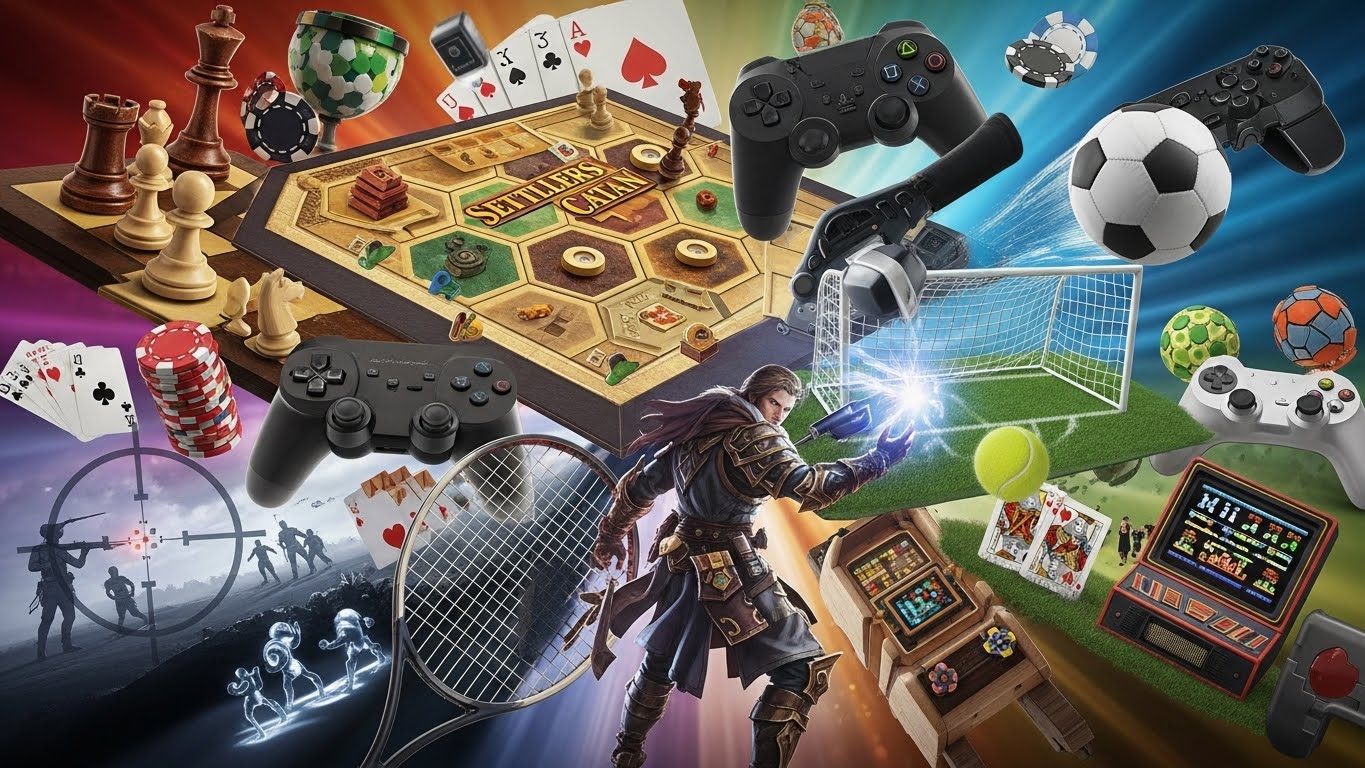
Games have been a part of human civilization for millennia, evolving from simple physical activities to complex digital experiences that captivate millions around the world. Whether we’re talking about board games, card games, video games, or sports, the concept of gaming has transcended cultures and generations. What was once a pastime for the few has now become a global industry, with billions of people engaging in some form of gaming every day.
In this blog post, we will explore the fascinating journey of games, from their humble beginnings to their role in modern society. We’ll delve into the different types of games that exist today, the technological innovations that have shaped the gaming world, and the profound impact games have on culture, entertainment, and even education.
The Origins of Games: From Ancient Civilizations to Classic Pastimes
The concept of games dates back to ancient civilizations, where people used games as a means of recreation, learning, and socialization. Archaeological evidence suggests that the first games were often simple in nature but served important cultural and social purposes.
Early Games in Ancient Cultures
Some of the earliest known games come from the ancient Egyptians, who played games like Senet, a board game that is over 5,000 years old. This game, believed to have had religious and spiritual significance, involved strategy and chance, and was played by both the elite and common people alike. Similarly, the ancient Greeks played a game called Petteia, which involved strategy and movement of pieces on a grid-like board, similar to modern-day checkers.
In ancient China, the game of Go was developed, which remains one of the oldest and most complex board games still played today. Go is a game of territorial control that involves strategy, foresight, and patience, and it has influenced many aspects of modern gaming culture.
The Evolution of Traditional Games
As civilizations advanced, so too did the complexity of games. By the time of the Roman Empire, games like dice and board games were common pastimes. The rise of chess during the medieval period is another significant milestone in the history of games. Originating in India around the 6th century AD, chess quickly spread to Persia, then to the rest of Europe, where it became a game of strategy and intellect, enjoyed by royalty and commoners alike.
During this time, card games also began to emerge, with the deck of cards as we know it today evolving from a Chinese invention into a game of worldwide popularity. These games, often played in social settings, became a way for people to connect, relax, and challenge each other.
The Rise of Video Games: The Digital Revolution
The second half of the 20th century witnessed the birth of an entirely new kind of game: video games. With the development of early computers and video game consoles, gaming entered the digital age, and the possibilities for creativity and entertainment seemed limitless.
The Birth of Video Gaming
The first commercially successful video game was Pong, released in 1972 by Atari. This simple game of ping-pong between two paddles captured the public’s imagination and was the starting point for what would become a massive entertainment industry. Video games quickly grew in popularity, and by the late 1970s and early 1980s, arcades filled with machines like Space Invaders, Pac-Man, and Donkey Kong became cultural landmarks.
The home console revolution came soon after with systems like the Atari 2600, the Nintendo Entertainment System (NES), and the Sega Genesis, which brought video games into living rooms across the world. These consoles, along with games like Super Mario Bros. and The Legend of Zelda, created new types of gameplay that combined storytelling, adventure, and action in ways that were previously unimaginable.
The 3D Revolution and the Golden Age of Gaming
In the 1990s, 3D graphics and more advanced hardware ushered in a new era of gaming. The Sony PlayStation, Nintendo 64, and Sega Dreamcast were among the first consoles to offer fully three-dimensional worlds, allowing players to explore expansive environments like never before. Games like Super Mario 64 and Final Fantasy VII pushed the boundaries of what video games could achieve, with more intricate storylines, complex characters, and immersive worlds.
The 1990s also saw the rise of the personal computer as a gaming platform. The advent of real-time strategy games like Warcraft and Command & Conquer helped establish PC gaming as a dominant force. As internet speeds improved, online multiplayer games like Quake and StarCraft brought players together from across the globe, giving rise to the vibrant community of gamers that we see today.
The Impact of Technology on Modern Gaming
Today’s gaming industry is driven by technological innovation, with advancements in hardware, software, and internet connectivity creating new possibilities for game design, gameplay, and player engagement. Technology has not only improved the graphics and mechanics of games, but it has also opened up new genres and experiences for players.
High-Definition Graphics and Realism
The advancement of graphics technology has allowed video games to achieve a level of realism that was once thought impossible. Modern consoles like the PlayStation 5 and Xbox Series X, as well as high-end gaming PCs, boast cutting-edge graphics, allowing games to showcase incredibly detailed environments and lifelike characters. Titles like The Last of Us Part II and Red Dead Redemption 2 feature photorealistic visuals that make it difficult to distinguish between game environments and real life.
Games are also using motion capture technology, where actors’ movements are digitally recorded and transferred to characters in the game. This has revolutionized character animation, allowing for more fluid and natural movements, making characters seem more human-like.
Virtual Reality (VR) and Augmented Reality (AR)
Virtual reality (VR) and augmented reality (AR) are two of the most exciting technological advancements in modern gaming. VR allows players to step into fully immersive digital worlds where they can interact with their surroundings in a way that feels more like real life. Games like Half-Life: Alyx and Beat Saber have demonstrated the potential of VR to provide an unparalleled level of immersion.
AR, on the other hand, blends the real world with virtual elements. Games like Pokémon Go have shown how AR can make gaming more interactive and engaging by overlaying digital objects onto the real-world environment. As these technologies continue to improve, we can expect even more innovative and immersive gaming experiences in the future.
Cloud Gaming and Streaming
Cloud gaming has emerged as a major trend in recent years, with services like Google Stadia, Xbox Cloud Gaming, and NVIDIA GeForce Now allowing players to stream games directly to their devices without needing expensive hardware. This has the potential to democratize gaming, as players with lower-end devices can access high-quality games via the cloud.
The rise of gaming streaming platforms, such as Twitch and YouTube Gaming, has also changed how people experience games. Players can now watch live broadcasts of professional gamers, eSports tournaments, and community-driven content, adding a social dimension to gaming that was previously absent.
The Diverse World of Games: From Casual to Hardcore
Today’s gaming landscape is incredibly diverse, with a broad range of genres and experiences catering to players of all types. Whether you’re a casual gamer who enjoys short sessions on your smartphone or a hardcore gamer who spends hours exploring vast open worlds, there’s a game for everyone.
Casual Gaming
Casual gaming has exploded in popularity, with mobile games, puzzle games, and social games appealing to a wide audience. Titles like Candy Crush, Angry Birds, and FarmVille have introduced millions of players to gaming in a low-pressure, easy-to-learn format. These games are designed to be played in short bursts, making them ideal for people with busy lives who want to unwind during their free time.
Hardcore Gaming
At the other end of the spectrum are hardcore gamers who seek deep, challenging, and often highly competitive experiences. These players tend to engage with games that require dedication, skill, and time investment. Popular genres include role-playing games (RPGs), first-person shooters (FPS), and real-time strategy (RTS) games. Titles like World of Warcraft, Call of Duty, and League of Legends have cultivated dedicated fan bases that are passionate about gameplay mechanics, team strategy, and in-game progression.
Esports: The Competitive Side of Gaming
Esports, or competitive gaming, has become a global phenomenon. Professional gamers now compete in high-stakes tournaments with prize pools worth millions of dollars. Games like Dota 2, League of Legends, Fortnite, and Counter-Strike: Global Offensive have transformed gaming into a spectator sport, with millions of fans tuning in to watch live broadcasts and streamers.
Esports organizations, teams, and sponsorships have created a thriving ecosystem that rivals traditional sports in terms of viewership, media attention, and financial investment. As a result, gaming is now seen as a legitimate career path, with professional gamers, coaches, and commentators becoming celebrities in their own right.
The Cultural Impact of Games
Games are no longer just a form of entertainment; they have become an integral part of modern culture. They influence everything from music and fashion to storytelling and art. The gaming community has grown into a vibrant, diverse global culture that spans across borders and languages.
Games as Storytelling
Many modern games are built around rich narratives and complex characters. Games like The Witcher 3: Wild Hunt and Red Dead Redemption 2 tell immersive, emotionally driven stories that rival the best movies and books. As the gaming industry continues to mature, games are being recognized as a legitimate storytelling medium, with writers, directors, and actors collaborating to create unforgettable experiences.