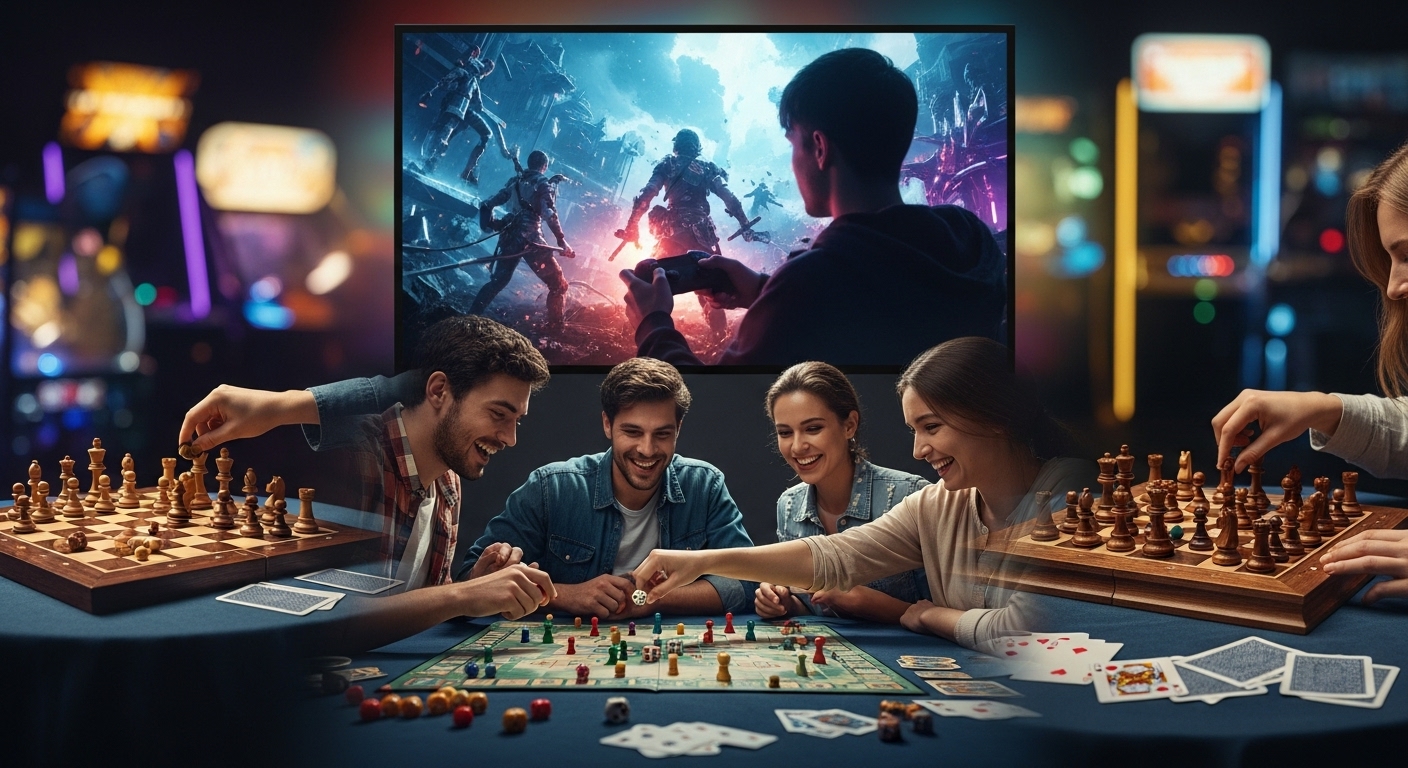
Gaming has long been a major part of human culture, offering entertainment, challenge, and a sense of achievement. What began as simple pastimes and social activities have now evolved into immersive, multi-billion-dollar industries that impact all generations. Whether on consoles, mobile phones, or computers, games have transformed from pixelated experiences to rich, realistic virtual worlds. In this blog post, we will explore the evolution of gaming, examine the different types of games available today, and discuss how gaming is shaping entertainment, social interaction, and technology.
The History and Evolution of Games
Games have been a part of human history for millennia. In fact, the earliest known games date back to ancient civilizations. Games like Senet from ancient Egypt, Go from China, and chess from India were played for centuries, but these were physical board games. It wasn’t until the mid-20th century that the concept of digital gaming was born.
The first video game, Tennis for Two, was created in 1958 by physicist William Higinbotham. It was a simple tennis simulation that was displayed on an oscilloscope. However, it wasn’t until 1972, with the release of Pong by Atari, that the gaming industry started to take shape. Pong, a basic two-player table tennis game, quickly became a sensation and laid the foundation for the gaming industry as we know it.
By the late 1970s and early 1980s, arcade games became a cultural phenomenon. Games like Space Invaders, Pac-Man, and Donkey Kong drew crowds to arcades across the world, and video gaming began to solidify its place in mainstream entertainment. During the same period, home consoles such as the Atari 2600 and the Nintendo Entertainment System brought gaming into people’s living rooms, expanding its reach.
The Modern Gaming Landscape
Today, the world of gaming is vast and diverse, with various platforms, genres, and ways to engage. The gaming industry is expected to reach over $200 billion in global revenue in 2025, making it one of the largest and most influential entertainment sectors worldwide. From blockbuster titles to indie games, the variety of experiences available to gamers is staggering.
1. Console Gaming: The Powerhouse of Interactive Entertainment
Console gaming, which includes platforms like PlayStation, Xbox, and Nintendo Switch, has been at the center of the gaming world for decades. These consoles deliver high-quality, immersive experiences and continue to be a dominant force in the market.
The PlayStation 5 and Xbox Series X represent the latest in gaming technology, offering stunning graphics, faster processing speeds, and expansive game libraries. Games like The Last of Us Part II, Spider-Man: Miles Morales, and Halo Infinite have pushed the boundaries of storytelling, graphics, and gameplay, making console gaming a premium entertainment experience.
Console gaming is often associated with high-budget, triple-A games that offer cinematic experiences. The integration of online multiplayer features, downloadable content (DLC), and expansive open worlds has become standard in many modern console games.
2. PC Gaming: The Hub for Enthusiasts and Creative Developers
PC gaming has long been seen as the domain of serious gamers who want the best performance, flexibility, and customization. With the ability to upgrade components, such as graphics cards, processors, and RAM, PCs offer gamers unparalleled control over their experience. Additionally, PCs offer access to gaming platforms like Steam, Epic Games Store, and Origin, where players can find thousands of games across all genres.
One of the key advantages of PC gaming is the ability to mod games. Players can change aspects of their favorite games, creating custom content, fixing bugs, or even creating entirely new experiences. Games like The Elder Scrolls V: Skyrim and Minecraft have thriving modding communities, where players can create new worlds, characters, and storylines.
Moreover, PC gaming has been central to the rise of esports—competitive gaming that has garnered huge audiences and prize pools. Games like League of Legends, Dota 2, and Counter-Strike: Global Offensive have elevated gaming to the level of professional sports, with international tournaments and a dedicated fanbase.
3. Mobile Gaming: A Game-Changer for Casual Players
In the past decade, mobile gaming has become one of the largest and fastest-growing sectors within the gaming industry. With smartphones and tablets now ubiquitous, mobile games offer players the ability to play anywhere, anytime.
From quick puzzle games like Candy Crush to complex strategy games like Clash of Clans, mobile gaming appeals to a broad audience, especially casual players who may not have the time or inclination to invest in console or PC gaming. The rise of free-to-play models with in-app purchases has made mobile gaming accessible to almost everyone, while also generating significant revenue.
Some of the most successful mobile games, such as PUBG Mobile, Fortnite Mobile, and Pokémon Go, have also introduced innovative gameplay mechanics and augmented reality (AR) features, adding new dimensions to mobile gaming. Mobile games are also a key entry point for younger audiences, with games like Roblox allowing kids to design and share their own experiences.
4. Virtual Reality (VR) and Augmented Reality (AR): The Future of Immersive Gaming
Virtual Reality and Augmented Reality have the potential to completely reshape the gaming experience. VR involves the use of headsets that immerse players in 3D, interactive environments, while AR overlays digital elements onto the real world through devices like smartphones or smart glasses.
VR gaming has seen significant advances in recent years, with platforms like the Oculus Quest and PlayStation VR offering high-quality VR gaming experiences. Games like Beat Saber, Half-Life: Alyx, and Star Wars: Squadrons have demonstrated the immersive potential of VR, where players can physically interact with the game world and experience it in ways that were previously impossible.
AR gaming, on the other hand, has been popularized by games like Pokémon Go, where players use their smartphones to catch virtual Pokémon in real-world locations. AR is still in its early stages, but it holds exciting possibilities for the future of gaming, including new forms of social interaction and location-based games.
Types of Games: Exploring the Different Genres
The world of gaming is diverse not only in terms of platforms but also in terms of genres. Different types of games cater to different tastes, skills, and preferences. Here are some of the most popular genres in modern gaming:
1. Action Games: Fast-Paced Thrills
Action games are typically characterized by fast reflexes, combat, and exciting gameplay. First-person shooters (FPS) like Call of Duty and Overwatch offer intense, fast-paced action where players compete against each other in real-time combat. Meanwhile, third-person action games like God of War and Uncharted focus on exploration, puzzle-solving, and dynamic combat sequences.
2. Role-Playing Games (RPGs): Immersive Worlds and Storytelling
RPGs allow players to step into the shoes of characters in rich, narrative-driven worlds. Western RPGs like The Witcher 3 and Mass Effect offer expansive open worlds where players can make choices that affect the story. On the other hand, Japanese RPGs (JRPGs) like Final Fantasy and Persona are known for their intricate plots, character development, and turn-based combat systems.
3. Strategy Games: Tactical Thinking and Planning
Strategy games require players to plan and think critically. Real-time strategy (RTS) games like StarCraft II and Age of Empires challenge players to build empires, manage resources, and outsmart opponents. Turn-based strategy (TBS) games, such as Civilization VI, let players take turns to plan their next move in a more methodical pace.
4. Simulation Games: Real-Life Experiences
Simulation games recreate real-world activities or systems. The Sims series, for example, allows players to control virtual lives and build homes, while games like Farming Simulator and Cities: Skylines let players manage entire communities or businesses. Flight simulators and driving simulators also fall into this genre, offering realistic experiences for those interested in vehicles and aviation.
5. Sports and Racing Games: Competing for Glory
Sports games like FIFA, NBA 2K, and Madden NFL bring the excitement of real-world sports to video game consoles. Racing games like Gran Turismo and Forza Motorsport deliver the thrill of high-speed racing, with realistic graphics and physics engines that allow players to race cars in meticulously designed tracks.
6. Indie Games: Creativity and Innovation
Indie games are often developed by smaller, independent studios and are known for their unique creativity and innovative gameplay. Games like Undertale, Hollow Knight, and Stardew Valley have gained massive followings for their compelling narratives, unique art styles, and engaging mechanics. Indie games often experiment with new ideas that may not fit into traditional genres, providing fresh and exciting experiences for players.
The Social Impact of Gaming: Connecting People Worldwide
Gaming is not just about playing solo; it’s also a social experience that brings people together. With the rise of online multiplayer games, players can connect with friends or strangers across the world. Games like Fortnite, Minecraft, and Apex Legends offer online communities where players can team up, compete, and share